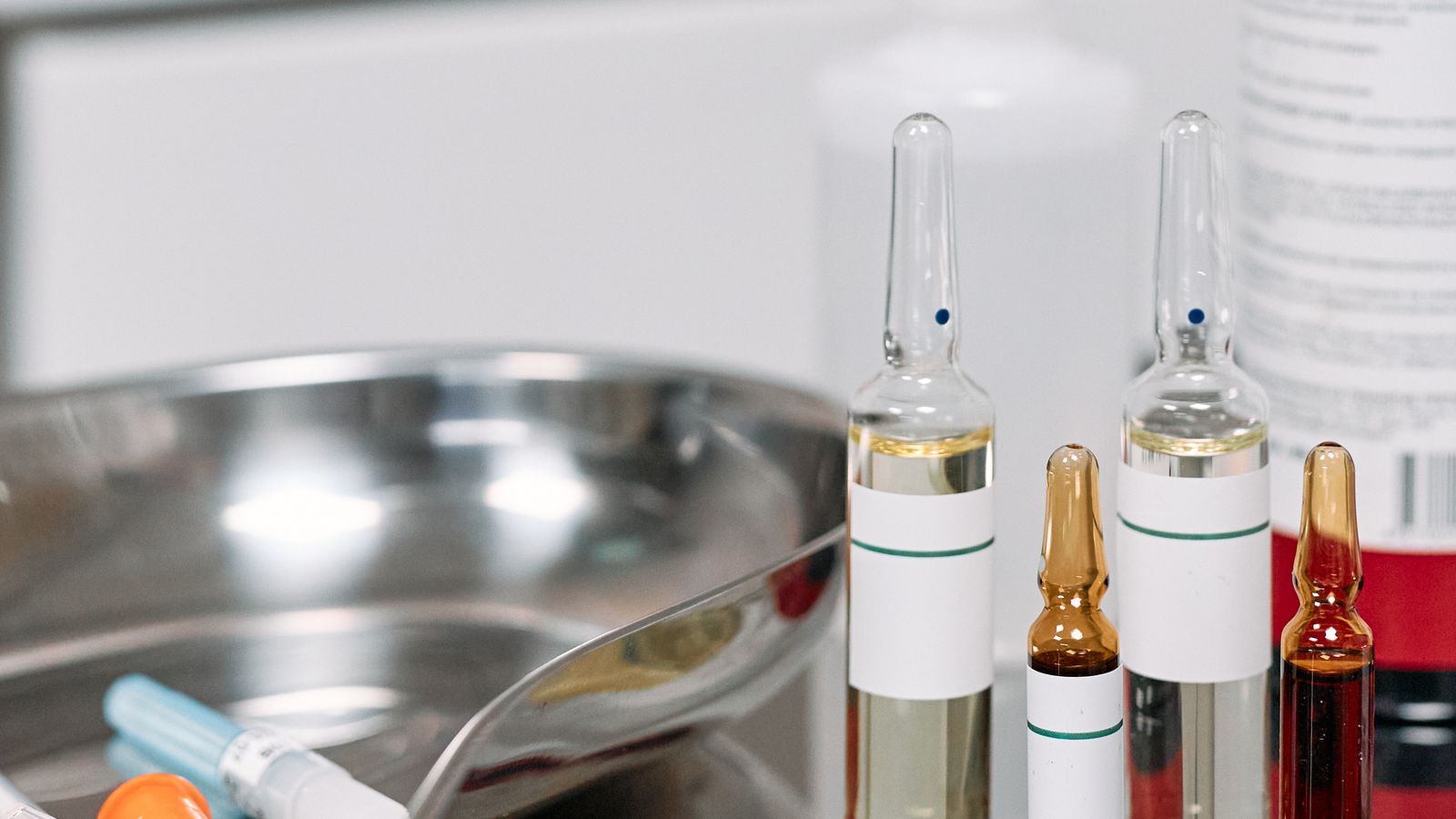
How to Convert Retatrutide Price Per Vial Into Price Per Dose
A walkthrough of the math behind converting a retatrutide vial's listed price into a per-dose figure, using concentration, reconstitution volume, and unit pricing.
Reviewed by Marcus Webb, PhD, research pharmacologist ·
Marcus Webb, PhD is a research pharmacologist with a doctorate from Johns Hopkins University and over 12 years of experience in receptor-selective peptide analogs, bioavailability science, and the pharmacoeconomics of emerging therapeutic compounds.
- retatrutide
- cost
- pricing
- reconstitution
A vial listing shows one number: total price for a fixed amount of peptide, usually 5 mg or 10 mg. That number alone does not tell a buyer much, because vials differ in mg content, and reconstitution choices change how much liquid that mg total is spread across. Converting retatrutide price per vial into price per dose requires three steps: find the concentration after reconstitution, define what a “dose” means in mg or mcg, and divide the vial price by the number of doses that concentration yields.
Why per-vial price is not comparable on its own
Two listings priced identically can represent very different value once broken down. A $180 vial at 5 mg and a $260 vial at 10 mg are not directly comparable from the sticker price alone — the second contains twice the peptide mass, so its per-mg cost is actually lower. Any comparison across sources has to normalize to a common unit, typically price per mg, before a per-dose figure can be calculated.
Step one: find the concentration
Concentration is the vial’s total mg divided by the volume of bacteriostatic water added during reconstitution:
Concentration (mg/mL) = vial mg ÷ mL of bacteriostatic water added
The vial’s mg content is fixed by the listing. The mL of diluent is chosen by whoever reconstitutes it, and that choice directly changes the concentration. Adding more diluent lowers the concentration; adding less raises it. This is the variable most per-dose calculators leave out, and it is the reason two people working from the same vial can report different per-dose costs.
Step two: define the dose in mg or mcg
Once concentration is known, a target amount — expressed in mg or mcg — determines how much volume corresponds to it. Since 1 mg equals 1000 mcg, converting between the two units just requires moving the decimal point three places.
A U-100 insulin syringe reads in units, where 100 units equals 1 mL. Combining that with concentration lets a volume be translated into units on a syringe, which is the practical form the math takes when someone is comparing listings rather than performing any of the math themselves.
A fully worked example
Take a vial listed at 10 mg for $260, reconstituted with 2 mL of bacteriostatic water.
Concentration = 10 mg ÷ 2 mL = 5 mg/mL
That is 5000 mcg/mL, since 5 mg × 1000 mcg/mg = 5000 mcg.
On a U-100 syringe, 1 mL = 100 units, so this concentration works out to 50 mcg per unit (5000 mcg ÷ 100 units = 50 mcg/unit).
Price per mg from the vial: $260 ÷ 10 mg = $26/mg.
If a listing’s reference point for “one dose” is 250 mcg (0.25 mg), the per-dose price is:
$26/mg × 0.25 mg = $6.50 per dose
The same vial reconstituted with 5 mL instead of 2 mL would change the concentration to 2 mg/mL (2000 mcg/mL), meaning more volume is needed to reach the same 250 mcg reference point, but the price per mg and therefore the price per dose from the vial’s total mg content stays the same — reconstitution volume changes concentration and injection volume, not the underlying price-per-mg economics. This distinction matters when comparing listings that quote different suggested dilution volumes.
Building a comparison table
When comparing several vial listings, laying out the inputs side by side makes the per-mg and per-dose figures easier to check for errors.
| Listing | Vial size | Price | Price per mg | Reference dose | Price per dose |
|---|---|---|---|---|---|
| A | 5 mg | $150 | $30.00 | 0.25 mg | $7.50 |
| B | 10 mg | $260 | $26.00 | 0.25 mg | $6.50 |
| C | 15 mg | $345 | $23.00 | 0.25 mg | $5.75 |
The pattern above is common across peptide listings generally: larger vial sizes often carry a lower price per mg, so the per-dose figure tends to drop as vial size increases, even when the headline price is higher. Recalculating from the vial mg and listed price, rather than trusting a pre-stated “per dose” figure on a listing page, is the only way to confirm that pattern holds for a specific source.
Where listing pages differ
Not every retatrutide listing states mg content, price, and suggested reconstitution volume in the same place, which is part of why buyers converting price per vial into price per dose end up doing the arithmetic themselves rather than trusting a vendor’s summary line. Some pages list a certificate of analysis with the actual measured mg content, which can differ slightly from the labeled amount — a detail worth checking against the label figure before running the conversion math, since the calculation is only as accurate as the mg number it starts from. Sourcing details, batch documentation, and catalogue breadth for retatrutide are outlined at heezresearch.com/product/retatrutide/, which lists the vial sizes and specification data referenced when doing this kind of comparison. For a broader read on how vial pricing trends across the market rather than one source, peer retatrutide listing catalogs track listings across multiple vendors and cover pricing structure for related compounds sold under similar per-mg conventions.
For anyone doing this math by hand repeatedly, a peptide reconstitution calculator such as peptcalc.com can cross-check the concentration and per-unit figures against the arithmetic above.
Summary
Converting retatrutide price per vial into price per dose comes down to three numbers: the vial’s total mg, the price paid for it, and the mg or mcg amount used as the reference dose. Dividing price by mg gives a comparable per-mg figure across listings, and multiplying that per-mg figure by the reference dose gives the per-dose price. Reconstitution volume changes concentration and syringe units, but it does not change the underlying per-mg economics — keeping those two calculations separate avoids the most common error in comparing vial listings.